
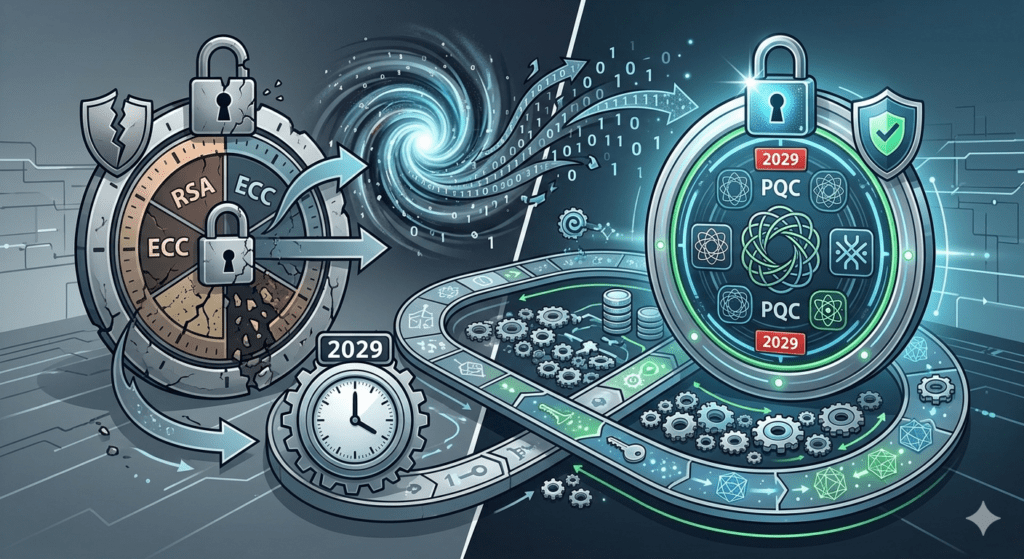
Quantum Readiness 2029: Why the Clock Is Ticking for Enterprise PKI
Google recently sent a wake-up call through the cybersecurity community by accelerating its timeline for “Q-Day.” Experts previously viewed the point when quantum computers could shatter modern encryption as a distant problem. However, the new target for quantum readiness 2029 forces enterprises to confront this threat within the next few years. This shift means that the cryptographic foundations we rely on today, such as RSA and ECC, face an expiration date. Consequently, organizations must act now to implement crypto-agility and protect their long-term data against “harvest now, decrypt later” attacks.
The Core Pillars of Quantum Readiness
To successfully meet the 2029 deadline, IT leaders must strengthen their cryptographic infrastructure across four critical domains.
1. Hardening Infrastructure Through True Crypto-Agility
Crypto-agility represents the ability of a system to switch cryptographic algorithms rapidly without requiring a total overhaul of the underlying code. Because NIST continues to refine its Post-Quantum Cryptography (PQC) standards, the algorithms you deploy today may require updates tomorrow.
If your applications contain “hard-coded” encryption parameters, you will face massive operational bottlenecks during the transition. Therefore, you must adopt a modular architecture that separates the application logic from the cryptographic provider. Specifically, a crypto-agile environment allows administrators to push new PQC standards—such as ML-KEM or SLH-DSA—across the enterprise through a central policy. This flexibility ensures that your security posture remains resilient as quantum threats evolve.
2. Managing the Complexity of Hybrid Certificate Workflows
The transition to a post-quantum world will not happen overnight. In fact, most legacy systems cannot yet process quantum-resistant math. To bridge this gap, enterprises must utilize “Hybrid Certificates.” These certificates include both a traditional signature (like RSA) and a quantum-safe signature.
Managing these dual-signature workflows introduces significant technical friction. Hybrid certificates are larger and require more processing power during the initial handshake. Furthermore, if the deployment process lacks discipline, these complex certificates can break legacy load balancers or older web servers. Achieving quantum readiness 2029 requires a system that can handle the increased overhead of these hybrid models while ensuring that every internal endpoint receives the correct credential type.
3. Protecting the Validation Chain Against Quantum Interception
Quantum computers threaten more than just stored data; they threaten the very process of trust validation. If an attacker uses a quantum computer to forge a digital signature during the domain validation phase, they can trick a Certificate Authority (CA) into issuing fraudulent credentials.
As we approach 2029, you must prioritize the security of your Certificate Revocation Lists (CRLs) and OCSP responders. These validation tools must eventually move to quantum-resistant signatures to prevent attackers from “revoking” legitimate certificates or validating fake ones. Moreover, any friction in this validation chain creates an immediate risk to service availability. Consequently, your crypto-agility strategy must extend beyond the certificates themselves to include the entire validation path.
4. Eliminating the Burden of Cryptographic Debt
Manual PKI management serves as the greatest barrier to quantum readiness 2029. Many organizations still harbor “cryptographic debt” in the form of undocumented certificates and manual renewal scripts. These ad-hoc methods cannot handle a wholesale migration to post-quantum standards.
Manual processes simply move too slowly to replace every certificate in a modern enterprise network. Furthermore, the risk of human error during a high-stakes migration often leads to widespread service outages. To survive the quantum era, you must replace manual workflows with automated enforcement. This transition ensures that your security team maintains total control over which algorithms reside on which servers, eliminating the “hidden” vulnerabilities that exist in unmanaged environments.
How CertAccord Enterprise Drives Quantum Readiness
CertAccord Enterprise by Revocent provides the enforcement and automation layer necessary to navigate this complex transition. We focus on the execution of your crypto-agility strategy rather than just monitoring the problem.
Policy-Driven PQC Enforcement
CertAccord Enterprise allows your administrators to define specific cryptographic standards in a central policy engine. As NIST finalizes new PQC standards, you simply update your global rules within the platform. Specifically, the system then enforces these new requirements across your entire environment. This proactive approach ensures that every newly issued or renewed certificate meets the 2029 standards by default, preventing legacy encryption from lingering in your network.
Automated Lifecycle Execution
Re-issuing an entire enterprise’s worth of certificates to meet quantum standards requires massive coordination. CertAccord Enterprise automates this rollout by pushing quantum-ready credentials to Windows, Linux, and macOS endpoints without manual intervention. By focusing on the end-to-end installation path, we remove the variability and risk associated with manual updates. Consequently, your organization can achieve quantum readiness 2029 with full confidence that your systems will remain secure and operational.
Final Thoughts
The move to 2029 signals that the time for theoretical discussion has ended. Quantum readiness 2029 requires a fundamental change in how your organization manages digital trust and crypto-agility. By automating your workflows and enforcing strict policies today, you protect your data from the quantum threats of tomorrow.
CertAccord Enterprise provides the structure you need to automate your PQC transition and maintain total control over your cryptographic posture. Thus, your systems remain secure in the quantum era without increasing your operational burden.