
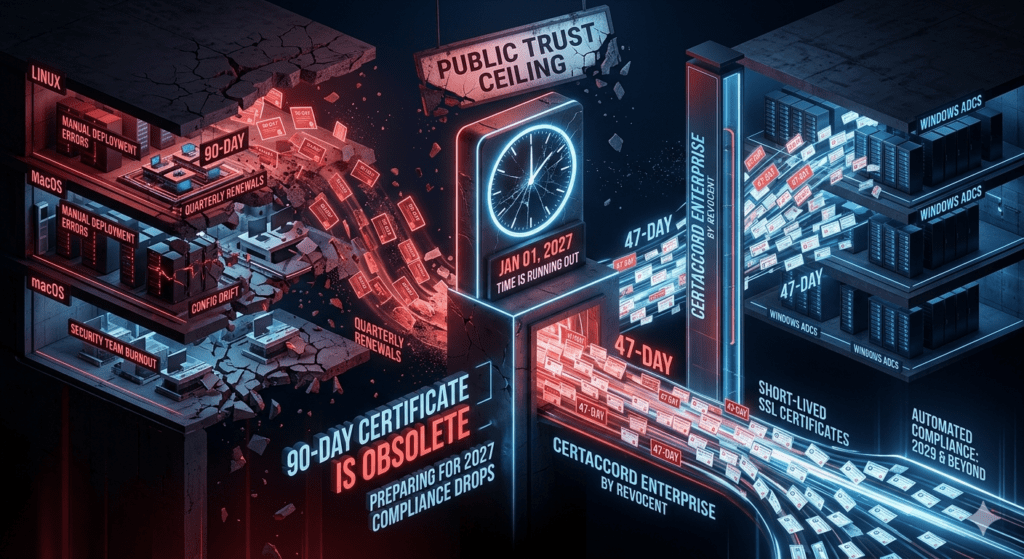
Why the 90-Day Certificate is Already Obsolete: Preparing for 2027
For years, enterprise IT departments viewed the three-month rotation cycle as the gold standard for modern cryptographic hygiene. Driven primarily by automated open-source certificate authorities, the 90-day TLS certificate forced organizations away from legacy, multi-year deployment models, establishing a faster, more secure standard for public-facing infrastructure.
However, regulatory realities have rapidly outpaced this benchmark. Because the Certificate Authority/Browser (CA/B) Forum passed Ballot SC-081v3, the industry is already moving down a strict, multi-year compression timeline. Consequently, treating 90 days as a modern standard is a critical mistake. If your administration strategies still treat three-month windows as a long-term plan, your architecture is already behind.
To future-proof your enterprise operations and safely navigate the upcoming 2027 compliance drops, engineering leadership must acknowledge that the era of the traditional 90-day TLS certificate has effectively ended. Transitioning your endpoints to accept hyper-frequent, short-lived SSL certificates requires addressing three immediate structural shifts.
The Core Shifts Rendering 90-Day Lifespans Obsolete
-
The Rapidly Approaching 100-Day Regulatory Ceiling: On March 15, 2027, the global public trust maximum shrinks down to a strict 100-day limit, leaving zero operational safety buffer for standard 90-day operations.
-
The Mathematical Certainty of a 47-Day Destination: The industry timeline terminates at a mandatory 47-day validity cycle by 2029, paired with a punishing 10-day domain validation reuse window.
-
The Broken Automation Path Across Mixed-OS Infrastructure: While native Windows ecosystems seamlessly rotate active keys through Active Directory, extending these rapid lifecycles to non-Windows platforms like Linux and macOS remains a massive manual bottleneck.
The Rapidly Approaching 100-Day Regulatory Ceiling
The primary reason a 90-day cycle is no longer a viable long-term baseline is the imminent compression of public validity rules. Specifically, the CA/B Forum schedule dictates that on March 15, 2027, the absolute maximum lifespan for any publicly trusted certificate drops to just 100 days.
When public CAs cap validity at this threshold, deploying a standard 90-day TLS certificate leaves you sitting just 10 days away from violating global browser trust rules at the exact moment of its issuance. This creates an unacceptably tight margin for enterprise IT infrastructure. If an engineering team experiences a minor API validation delay, a localized network timeout, or a temporary configuration error during a scheduled quarterly rotation, the certificate can easily cross that 100-day boundary.
Because CA/B Forum validity limits are precise down to the second, exceeding the cap by even a single moment constitutes misissuance and triggers mandatory revocation. This razor-thin operational buffer transforms what used to be a routine background task into an ongoing compliance hazard.
The Mathematical Certainty of a 47-Day Destination
Focusing on a quarterly rotation strategy completely ignores the true destination of current internet security mandates. The 100-day drop in 2027 is merely a stepping stone toward the ultimate implementation of a mandatory 47-day certificate lifespan on March 15, 2029.
As we detailed in our analysis of the 47-day certificate lifespan framework, this final shift forces an eightfold increase in the sheer volume of renewals your staff must manage annually. Under our legacy frameworks, teams processed renewals roughly once or twice a year. By March 2027, transitioning from a 90-day TLS certificate to a 100-day cap forces a four-times-per-year cadence, before finally escalating to a staggering eight renewals per certificate annually once the 47-day limit takes full effect in 2029.
However, the hidden technical landmine in Ballot SC-081v3 isn’t just the certificate lifecycle—it is the compression of Domain Control Validation (DCV) data reuse. Historically, once you proved domain ownership to a CA, that validation remained active for over a year. Under the new rules, this validation window shrinks from the traditional 200 days down to a mere 10 days by 2029. This means your infrastructure must respond to live DNS or HTTP-01 challenges roughly 35 times per domain every single year. If your team continues to build workflows tailored for three-month intervals, your entire pipeline will completely stall under the velocity of the 10-day DCV reuse limit.
The Broken Automation Path Across Mixed-OS Infrastructure
The true operational danger of adapting to hyper-frequent, short-lived SSL certificates lies within fractured, multi-operating-system enterprise environments. For pure Windows environments, Active Directory Certificate Services (ADCS) can easily distribute, enroll, and rotate keys automatically behind the scenes. However, the modern enterprise ecosystem is rarely uniform, and when you introduce critical enterprise Linux servers and corporate macOS endpoints into that loop, native cross-platform automation breaks down entirely.
Maintaining a legacy 90-day TLS certificate lifecycle on non-Windows endpoints was already an inefficient use of engineering hours. Without native cross-platform support linking non-Windows endpoints to your central Windows PKI, security teams must step in and execute a disjointed, manual workflow every few weeks. Engineers are forced to:
-
Manually generate Certificate Signing Requests (CSRs) on individual Linux nodes.
-
Securely transfer those files across environments to request issuance.
-
Move the completed certificates back to the target endpoints.
-
Manually reload background web daemons and application containers to apply the new keys.
Executing this fragmented process across hundreds of non-Windows endpoints every month introduces immense configuration drift and human errors. This administrative overhead directly accelerates security team burnout, turning highly skilled engineers into full-time certificate administrators.
Navigating Short-Lived SSL Certificates with Revocent
Fortunately, navigating this rapidly shrinking compliance timeline does not require a bloated, complex platform that attempts to inventory or scan your entire network ecosystem. Instead, your enterprise simply needs a tool that can reliably automate execution at the endpoint level, specifically targeting the non-Windows devices where the operational friction is highest.
CertAccord Enterprise addresses this challenge directly by seamlessly bridging the gap between Microsoft ADCS and your open-source environments. Rather than forcing engineers to manually touch every Linux server or macOS device as validity windows shrink, CertAccord operates as an automated agent. It handles the entire lifecycle seamlessly—automatically requesting, installing, and renewing short-lived SSL certificates using your existing, trusted Windows PKI infrastructure.
In conclusion, you must prepare your enterprise architecture for the post-90-day landscape well before the 2027 regulatory deadlines arrive. By relying on CertAccord Enterprise to automate the deployment of short-lived SSL certificates across your mixed-OS infrastructure, you remove the manual burden from your staff. Ultimately, your network remains continuously compliant, your systems stay safely online, and your team remains focused on high-value security operations.