
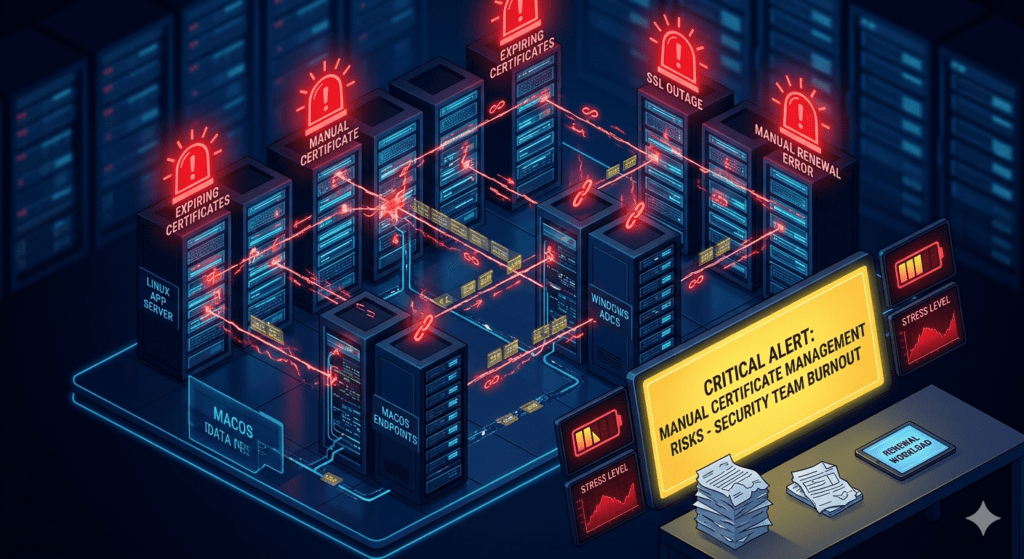
How to Avoid “Certificate Renewal Burnout” in Your Security Team
Cybersecurity professionals currently face an unprecedented wave of systemic fatigue. Between triaging active threats, patching zero-day vulnerabilities, and maintaining complex compliance frameworks, organizations stretch their engineering resources incredibly thin. Consequently, one of the most common catalysts for modern security team burnout isn’t a highly sophisticated external exploit—it is the relentless, high-stakes chore of manually renewing digital certificates.
When organizations force highly skilled engineers to constantly track, generate, and deploy cryptographic keys just to keep enterprise systems from going dark, those engineers cannot dedicate time to strategic defense. Instead, they operate in a perpetual state of survival. This administrative burden will only intensify as the industry transitions toward a strict 47-day certificate lifespan under recent CA/Browser Forum mandates. Ultimately, relying heavily on human intervention to handle this high-velocity crypto-shuffling introduces severe manual certificate management risks that grow exponentially more dangerous as your corporate infrastructure scales.
Therefore, to safeguard your operational uptime and retain your top security talent, your enterprise must transition away from high-stress manual interventions. By directly addressing these critical pressure points, you can eliminate renewal fatigue for good and restore engineering focus.
The Core Drivers of Renewal Fatigue
-
The High-Stakes Penalty of a Single Omission: Missing a single expiration date triggers an immediate, highly visible outage that disrupts business operations and forces teams into emergency firefighting mode.
-
The Friction of Cross-Platform Deployments: Manually provisioning Microsoft Active Directory Certificate Services (ADCS) certificates to non-Windows platforms like Linux and macOS creates massive operational drag.
-
The Looming Threat of Shorter Validity Windows: Global industry shifts toward shorter certificate lifecycles mean your team must repeat the exact same tedious renewal tasks twice as often.
The Operational Pressure of High-Stakes Outages
The absolute zero-error threshold dictated by public key infrastructure rapidly drains an engineering team’s morale. For example, in most standard IT tasks, a minor oversight or configuration mistake results in a low-priority ticket that engineers can resolve during normal business hours. However, with digital certificates, a single forgotten expiration instantly breaks the chain of trust. This single oversight can take revenue-generating web applications offline or abruptly sever critical machine-to-machine communications.
As a result, this unforgiving technical environment creates an ongoing, baseline level of operational anxiety. Engineers constantly live in fear of the next unexpected expiration, which inevitably leads to a highly reactive, stressed corporate culture. Thus, instead of proactively hardening infrastructure or architecting robust defense systems, your top talent spends valuable, expensive cycles scrambling to fix entirely avoidable outages under intense executive scrutiny and mounting downtime costs.
The Friction of Cross-Platform Deployments
For environments running primarily on Windows, Microsoft Active Directory natively handles certificate enrollment and renewal seamlessly behind the scenes. However, the modern enterprise ecosystem is rarely uniform, almost always requiring a mix of diverse operating systems. Furthermore, when engineers must extend those rigid internal security policies to enterprise Linux servers and corporate macOS endpoints, that native automation breaks down entirely.
Without native cross-platform support, security teams must step in and execute a disjointed, manual workflow for every single non-Windows device. They must manually generate Certificate Signing Requests (CSRs), securely copy files back and forth across environments, and manually restart background daemons to apply the new keys. Because of this highly fractured process, organizations face compounding manual certificate management risks, introducing configuration drift and human errors that inevitably lead to hidden security vulnerabilities or broken internal trust chains.
The Impact of Shorter Industry Validity Windows
The administrative burden of this process is rapidly intensifying across the entire IT landscape. Specifically, as internet security standards and major browser vendors aggressively push for shorter certificate validity periods to enhance encryption safety, they make the lifestyle of the manual administrator unsustainable. The sheer volume of annual renewals required to maintain the exact same infrastructure is skyrocketing.
These shifting industry conditions easily accelerate security team burnout. If your engineering team already struggles to maintain compliance under traditional annual or biennial certificate schedules, doubling or tripling that operational workload without changing your fundamental tooling guarantees operational failure. Therefore, leadership cannot simply expect teams to work faster, remember more deadlines, or log longer hours to keep up with the compounding volume of manual lifecycle tasks.
Mitigating Manual Certificate Management Risks with Revocent
Fortunately, you do not need a bloated, complex platform that promises to scan your entire network or inventory every forgotten asset just to solve this specific, acute pain point. Rather, you simply need to automate the actual execution of the certificate lifecycle work where it hurts your engineering team the most: your non-Windows endpoints.
CertAccord Enterprise directly targets the root causes of security team burnout by seamlessly bridging the operational gap between Microsoft ADCS and your open-source environments. Instead of forcing engineers to manually intervene every time a Linux server or macOS device needs a certificate renewed, CertAccord acts as a purpose-built, automated agent. It securely requests, installs, and renews certificates automatically directly from your existing, trusted Windows PKI infrastructure.
In conclusion, prepare your enterprise today for the unavoidable reality of the impending 47-day certificate lifespan before the compounding volume of renewals overwhelms your staff. By offloading the repetitive, high-stakes mechanics of cross-platform enrollment to CertAccord Enterprise, you eliminate the operational friction that drives top technical talent away from your organization. Ultimately, your corporate infrastructure stays continuously compliant, your production systems stay safely online, and your security team can finally focus on what they do best—protecting and defending the enterprise.